Since reforming with new drummer Ray Phillpott in 2008, Luton’s
Godfathers of Goth, UK Decay have been
playing the festival circuit around Europe and
conjoured up enough new material to return to the recording studio for the
first time in almost 30 years. They need your help to make this happen though
kiddies, and following the very effective strategy employed in 2010 by The March Violets have gone through Pledge Music to raise some much needed dosh.
Just click here to provide UK Decay a helping hand and be a
part of what promises to be a very exciting musical outing.
UK Decay live at the DV8 Fest in York, July 2011
In other news, Australian ex-pats and gods of neoclassical/world music and
ambient/ethereal Goth , Dead Can Dance have somehow sneakily reformed sometime
last year without my noticing and are now threatening both a new album and a
world tour for 2012. Click here to sign up to their news updates, and they’ll
very nicely give you the free download EP "Live Happenings Part II" recorded
during their 2005 reunion tour.
Track Listing:
The
Love That Cannot Be
The
Lotus Eaters
Crescent
Minus
Sanctus
Dead Can Dance live in 2005
Man, they better come
to Perth or I’m
going to be seriously pissed.
Another tragic loss to the ravages of time, Mick Mercer once referred to these kids as “lost Goth giants”, thereby contradicting his own earlier statement that the rise of Goth “can truthfully be traced only as far back as the rise of Bauhaus” (Mercer, The Gothic Rock Black Book, Omnibus Press, 1988).
Gloria Mundi started coming to public attention supporting early John Foxx-era Ultravox! Indeed, saxophonist C.C. actually worked as a session musician on the track “Hiroshima Mon Amour” on the second Ultravox! album Ha!-Ha!-Ha! (Island Records, 1977), and bassist Ice had previously played in an outfit known as Yours with early Ultravox! guitarist Stevie Shears.
Highly theatrical in their live performances, Gloria Mundi stood apart from the majority of their post-punk peers in being driven more by a sense of gloom than by any more nihilistic tendencies, a noose reportedly gracing their stage on regular occasions.
First materializing on vinyl with the Fight Back! single (RCA, 1978), the astonishing musical document that is I, Individual was their first full length release. Complex and diverse, the album ranges from the outright punk of “Split Personality” through to longer labyrinthine arrangements that suggest the band may have been more than passing fans of Eno-era Roxy Music. A strong flavour of performance art remains throughout, providing a thread that would later be picked up by early Dark Cabaret artists, most noticeably Sex Gang Children.
I-Individual
The Pack
Split Personality
Perhaps too far left of field for their time to gain widespread acceptance, the true legacy of Gloria Mundi remains as being the nurturing uncles of the then nascent Bauhaus, inspiring the latter as their support band to adopt a more refined image that would become the template of the ten million Goth acts that would follow in their wake.
Several more singles and a second album, The Word is Out (RCA, 1979) would follow, before Gloria Mundi would dissolve, leaving Eddie and Sunshine to continue as the imaginatively named Eddie and Sunshine who released several singles and at least one LP, Perfect Strangers in 1983, described as “synth-pop” through Survival Records. Sunshine continues to work under the name Sunshine Gray.
I think we should let Mick Mercer have the final word here, writing in the introduction to his self published (?) photo book of Gloria Mundi : “Indisputably the first Goth band”.
And brilliant they were.
Line Up: Eddie Mealoy (vocals), Sunshine Patteson (vocals, keyboards), C.C. (saxophone), Ice-AKA Roland Oxland (Bass), Beethoven – AKA Pete Vas (guitar), Mike Nicholls (drums)
The line-up of Gloria Mundi seems a little dubious. While everyone agrees on Eddie and Sunshine as core members, there is little consensus on anyone else. Who was actually in the band and who were hired guns along for the ride seems to depend largely on who you read.
This is the rear cover for I, Individual, but the
track order (at least on the version I own) is completely wrong.
She gets around the German music scene does this Gudrun Gut lass.
From being a member of the original line up of the groundbreaking and highly influential industrial outfit Einsturzende Neubauten, she moved on to Mania D before forming Malaria!, an astonishing and brilliant all-girl project who’s early works defy easy classification.
This of course raises the question; if the style of Malaria! can’t be easily defined, do they belong here at all? It’s an interesting and difficult question.
I think the answer is best served by saying that Malaria! were in no way a Goth band, but they did like to dabble in the post-punk style that would later become understood as “Goth”, and when they dabbled they did it very, very well. And to amazingly good effect on songs like "Tod / Death" and "Kalte Klares Wasser". The afterthought does occur, that if Malaria! had appeared a decade later, it's easy to imagine that they would have fallen under the Darkwave umbrella.
Tod / Death and Geld / Money appeared on the Malaria! debut full length Emotion (Moabit Musik, 1982)Most of which appears on Compiled. “Kaltes Klares Wasser” appeared on their second Malaria!_...Revisited (ROIR, 1983) and became their main hit although why they opted to wait almost a decade to release it as a single (Moabit Musik, 1991) is anyone’s guess. It didn’t hurt them though, since they got a second bite of the cherry when it was covered (albeit to vastly lesser effect) by ChiKs on Speed (Superstar Recordings, 2001).
Kalte Klares Wasser
Tod
Geld
So, let us return to the question – do they belong on here?
The easy answer is "well...not really”, At least not in any purist sense. Malaria! touched on the Goth subset rather than overlapping it, but their “dabblings” are exceptional. Then, there are also clear overlaps with fellow German artists Lene Lovich, Nena Hagen, X-Mal Deutschland and Einsturstende Neubauten (the last, perhaps inevitable). If you like these artists (and chances are if you’re reading this site, then you probably do), then Goth or not, you want this album.
That Malaria! have been lost to time is simply criminal.
Highly recommended.
Gudrun Gut went onto the band Matador and continues to run the record labels Monika Enterprise and Moabit Musik while co-hosting a weekly radio show Ocean Club in Berlin and releasing a number of albums, both solo and in collaboration with Myra Davies.
Moabit would re-release Compiled in 2001 with alternative cover art.
Track listing:
1. How Do You Like My New Dog?
2. Kaltes Klares Wasser
3. Geh Duschen
4. Zarah
5. Your Turn To Run
6. Thrash Me
7. You You
8. Dabo
9. Geld / Money
10. Leidenschaft / Passion
11. Eifersucht / Jealousy
12. Einsam / Lonesome
13. Macht / Power
14. Tod / Death
15. Mensch
16. Gewissen
Line up:
Gudrun Gut (guitar, drums, backing vocals), Bettina Koster (vocals, saxophone), Chrisine Hahn (drums, guitar, keyboards), Manon P. Duursma (guitars), Susanne Kuhnke (synthesizer).
I actually own several Inca Babies albums, but This Train has always been my personal favourite. Thundering out of Manchester in 1982 (or was it 83? Their own official site is a bit unclear on this), Inca Babies were another of the bastard children unintentionally spawned by pervasive influence of The Birthday Party and other acts in the Psychobilly vein. C.P Lee, author of several books on the Manchester music scene would later describe them as “the Hulme Cramps”.
The Interior 7” (Black Lagoon Records, 1983) on the band’s own label set the ball rolling, several other singles and 12” releases emerged before the debut LP appeared. Always ones to wear their influences on their sleeve, Rumble (Black Lagoon Records, 1984) took its name from an influential Link Ray song, and the cover art for The Interior depicts a dubious looking character apparently wearing a “King Ink” t-shirt. In the grand spirit of handing things down though, Rumble did contain a song called “Cactus Mouth Informer” , which now lends its name to a rather good blog, but I digress…
All this brings us to the This Train album (Black Lagoon Records, 1986), or to give it it’s full title; “This Train is Bound For Glory”, itself a Johnny Cash Song. The album itself remains a favourite of mine – imagine The Birthday Party stripped of the chaos and a slow surf-rock feel installed in its place.
Proceeded by the single “Splatter Ballistics Cop” (Black Lagoon Records, 1985), This Train is essentially an album of two gears – the relatively faster songs owing much to Birthday Party numbers like “Sometimes Pleasure Heads Must Burn” or “Release the Bats”, interspersed with the much slower, more in the mould of “She’s Hit” or “Deep in the Woods”.
After the release of This Train, the LP Opium Den (Black Lagoon Records, 1987) follows, but things seem to begin falling apart with various members leaving, and extensive tours of Europe, but little media coverage in their native UK. The Final LP Evil Hour (Constrictor, 1988) would see a significant change in direction, including keyboards provided by Clint Boon of Inspiral Carpets (well, it was Manchester afterall). The band themselves admit on their blog that they were disappointed in it. Personally, I’ve owned a copy of Evil Hour for many years in which time I think I’ve listened to it once which probably speaks for itself.
Happily though, in 2006 Cherry Red/Anagram Records approached the group to produce a best-of compilation which became Plutonium 1983-87 (notably excluding the Evil Hour period). You can get this from iTunes but inexplicably must download it as individual tracks rather than as one album. Still, I’d very much like to own this and will probably end up ordering a physical copy from Amazon.com – whoops, I just did.
Around this time, The Inca Babies roar back into life with a series of international gigs and in 2008 beginning to record a new album Death Message Blues (Black Lagoon Records, 2010) with 12 new songs on it. They no longer sound like The Birthday Party, although through an intriguing evolutionary process, they do now sound a lot like The Bad Seeds. Unfortunately, as Harry Inca records on the band’s blog, bassist Bill Bonny didn’t live to see the album’s release, apparently making a self-inflicted and sadly premature exit.
RIP Bill – and thank you for the music.
Track Listing
Plenty More Mutants
Correction Stack
Hole in the Gulley
CandyMountain
Splatter Ballistics Cop
The Depths
Backyard Bones
Daniella
Call Me Enemy
Correction Stack, Daniella and Plenty More Mutants all appear on the compilation Plutonium 1983/87 (Anagram Records, 2006). The Depths is also included, although curiously mislabeled as Big Cypress.
Line Up:
Mike Lairs (vocals, harmonica), Harry Stafford AKA: Harry Inca (Guitars, piano), Bill Bonny (bass), Pete (drums, percussion, metal).
What we have here is something much earlier, much more obscure, and from, of all places, Norway. Indeed, I must confess to having stumbled across them quite by accident on the net while looking for something entirely different.
Apparently one of the first Goth bands in Norway but beyond that, not much information is available here, and short of any native Norwegian speakers with an access to fanzines of the time, I doubt there ever will be.
Garden of Delight popped out two singles in 1984 of which “Blessed Minutes” and its B-Side “Glory”, appears to have been the first. It may not be the be all and end all of Goth, but I’ve certainly heard far worse. They clearly had a taste for nice Pornography-era Cure style instrumentation, but whether getting in session musicians to include a horns section on “Blessed Minutes” was a good idea remains debatable.
Despite its eccentric beginning and unusual lyrics (perhaps “glory to your broken leg” sounds slightly less daft in Norwegian?) “Glory” is a much stronger song, leaving one to speculate on why it was the B-Side? Stranger still, why make a video clip for the B side of a single? Meanwhile, the art work for the B-side certainly suggests the Norwegian music scene may have had a taste for blasphemy long before the Black Metal explosion of the early 90s.
By 1987 Garden of Delight had apparently shed the Goth trappings, releasing their only full length album Big Wheels in Emotion (Pale Records) which I can’t claim to have heard, but the cover art certainly doesn’t inspire confidence. Nor does the fact that no one seems to have uploaded any tracks from it onto Youtube, or that the band seems to have vanished into the void of obscurity shortly thereafter.
Rather more interesting though is Garden of Delight’s second single "22 Faces" (Moonlight Productions, 1984), not so much for its quality, it is in fact a substantially wimpier beast than its predecessor, as for The Strange Tale of The Riff That Wouldn't Die.
Does that sound familiar?
It should, because it’s extremely close to the riff used by Nirvana on their 1991 single “Come as You Are”. Yes! That riff! The one Killing Joke threatened to sue them for ripping off their 1985 song “Eighties”. A threat of legal action that must have taken considerable chutzpah, considering that not only did Garden of Delight beat Killing Joke to it by a year, but also, that the riff seems to have originally come from the 1982 song “Life Goes On” by The Damned, who so far have been very nice indeed in not threatening to sue anyone.
Youtube does also seem to have a couple of tracks from Garden of Delight's 1983 demo which for the sake of completeness we may as well include.
Well, this is going to be a difficult one to cover since the band’s official sites, their Wikkipedia entry and Discogs.com entry don’t actually seem to be able to agree on any basic facts like dates and much information like who played what and when is simply absent.
Perhaps we can focus on what we do know and simply hope for the best?
Coming out of the Netherlands in 1983 (or 1981, depending on who you believe) Clan of Xymox were led by Ronnie Moorings, who remains a distinctive entity by remaining the sole constant figure throughout their various incarnations.
Never one to let a truly diabolical hairstyle stand in the way, Ronnie led his band, originally known as just Xymox to change their name to Clan of Xymox, to move to England and release a self titled album (4AD, 1985) containing the astonishing single “One Day”.
Clan of Xymox are best remembered though for their second studio release Medusa which came out on 4AD in 1986 (or 1987 if one believes the band’s official sites – I’m personally more inclined to believe the 1986 date stamped on the back of my 4AD copy).
I love the Medusa album – it’s pretty, it’s introspective, it’s darkly ambient, it’s soothing. Other commentators have suggested it may have pre-empted the Darkwave movement. Medusa remains a wonderful album and well worth your time.
A brief aside: I personally remain suspicious of “Darkwave” – initially it was used as a genre label designed to describe those more electronic Goth bands in the 90’s, especially European acts, who didn’t fit into the Sisters/Nephilim template. Nevertheless, it was later bandied about, abused (much as the term "Goth" is nowadays) and applied to pretty much anything in the mid 90’s that didn’t quite fit. I once saw a record catalogue from a normally very reputable distributor that had 45 Grave of all things listed under “Darkwave” which I daresay would have surprised Dinah Cancer greatly.
I'm not clear about the vintage of these first two live clips. The first, "Louise" seems relatively recent. The second, "Michelle", I suspect is considerably older, possibly even dating from the Medusa period, but then, with Xymox's penchant for chronological inaccuracy, your guess is as good as mine.
The one thing in my humble opinion that stops Medusa from claiming total brilliance, is that it didn’t include “A Day” from their first album, and one of the great break-up songs of all time (All right – one of my great break-up songs of all time). But this is my fewkin’ blog, so for the sake of magnificence, here it is anyway:
After Medusa, the band would reincarnate themselves, losing the “Clan of” somewhere around 1988 to become just Xymox once again and release a large number of albums in a more non-goth but dance oriented vein. The discography on the band’s official sites curiously includes all these releases, but is very coy about mentioning the change in direction.
Somewhere around 1997 however sees Ronnie (now the sole remaining original member) having a “road to Damascus” moment and the Goth version of Clan of Xymox is reborn. This nicely anticipates the more electronic direction of Goth’s third wave and a string of much more Gothy albums, both studio and live would follow, much of which was very good indeed.
They may not be up there with Bauhaus or Sisters of Mercy in terms of influence, but Clan of Xymox are indisputably one of the longest living and prolific Goth bands on the planet.
Track Listing:
Theme I
Medusa
Michelle
Theme II
Louise
Lorrentine
Agonised by Love
Masquerade
After the Call
Back Door
The 2000 re-release through 4AD on CD also contains bonus tracks Blind Hearts, A Million Things and Scum, although none of these are listed on the album sleeve.
Line Up: What an excellent question! Ronnie Moorings was definitely there and the rest of the original line up according to Wikkipedia was Peter Nooten, Frank Weyzig and Anka Wolbert. Gothic Rock (Mercer, Pegasus Publishing, 1991) suggests Ronnie Moorings on vocals, keyboards and guitar, Anka (Anke?) Wolbert on bass, keyboards and vocals, Pieter Nooten on keyboards, vocals and someone called Burt Bartan on keyboards. This was written much later than Medusa however, and one can only speculate as to the lineup that actually went on to play on that album. The 4AD site does note that Ronnie, Pieter and Anke were the main songwriters. Better information is welcomed.
Another entry in the “before they were famous” category, Psi Com being the first band to feature the talents of Perry Farrell, later of Jane’s Addiction, Porno for Pyros and Lollapalooza fame. Percussion was far from orthodox, utilizing hubcaps and car engine blocks as well as more conventional drums.
The self-titled EP was the only official release by Psi Com. Pressings were limited to 1500 vinyl copies on the band-owned label. This in itself would have made it rare enough, but more than half the original pressings were warped (and one presumes, unplayable), a factor reportedly intrinsic in Psi Com’s soon to follow break up.
It’s an intriguing album that abounds with allusions to American Indian culture, Hindu mysticism and Aleister Crowley’s system of tarot. At first glace, the cover art appears to be a girl dancing along the shoreline, but closer inspection reveals this to in fact be a corpse superimposed on the background photograph. The album itself eases in and out of tribalistic rhythms, psychedelic influences and odd moments of introspection. Despite this though, there remains something oddly disengaged and detached about the experience that is difficult to put your finger on. Perhaps it’s easier if you listen for yourself:
Track Listing:
Ho Ka Hey
Human Condition
Xiola
City of 9 Gates
Winds
The self titled E.P was later re-released on CD by Triple X Records (1993) and is still available. However, should you be one of those die-hard vinyl junkies, at time of writing a copy of the original pressing is for sale on Amazon.com - it can be yours for a very reasonable $1,600 USD.
Line Up: Perry Farrell (vocals, percussion), Vince Duran (guitar), Kelly Wheeler (bass), Aaron Sherer (drums).
The mere idea of trying to objectively review this one actually terrifies me beyond belief.
As with any scene, there is justifiable argument about where Goth started; Siouxsie, Joy Division, Gloria Mundi, Killing Joke, UK Decay and others all laid the groundwork, but it was Bauhaus with the deliberately toungue-in-cheek Bela Lugosi’s Dead (Small Wonder Records, 1979) that unintentionally both defined and refined a genre.
Although three-quarters of Bauhaus had known each other through various bands kicking around Northampton previously, the band coalesced when Pete Murphy was asked to join as vocalist, an inspired choice since despite a lack of either musical or lyrical experience he would go on to become one of the most legendary front men the post-punk scene would ever produce.
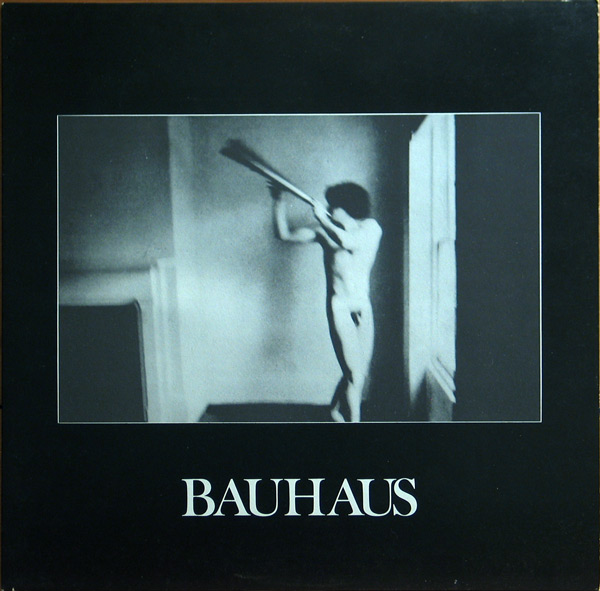
Initially known as Bauhaus 1919, the numerals were long gone by the release of Bela Lugosi’s Dead. Several more singles followed; Dark Entries (Axis, 1980), Terror Couple Kill Colonel (4AD, 1980), and a cover of T-Rex’s Telgram Sam (4AD, 1980) before the band rolled out In the Flat Field (4AD, 1980), thereby releasing the first full length LP that indisputably belonged to the then nascent scene.
After so many years of DJing Goth clubs and radio shows, this seems a quite extraordinary mea culpa, but apart from compilations and the exemplary Press the Eject and Give me the Tape live album (Beggars Banquet, 1982), it’s only in recent years that I’ve ever owned an actual studio album by Bauhaus, so it’s genuinely interesting to hear this.
While I usually place much emphasis on listening to the original album under discussion, in the case of In The Flat Field this doesn’t actually add much since so much of it has already included on many well-known compilation albums. Nevertheless, these familiar numbers set the template for everything that followed and are well worth revisiting.
Anyhow, no serious exploration of the early scene can realistically avoid including them.
Although the album does include lesser tracks like “Dive” and “Small Talk Stinks”, I do think the closer “Nerves” is frequently overlooked, is generally not included on best-ofs and rates a special mention. Beginning in a fairly nondescript fashion, this number builds and builds until the album climaxes in an aggressive and neurotic explosion as Pete chants “NERVES OF NYLON, NERVES OF STEEL” over and over again, thereby concluding In the Flat Field in a manner both disconcerting and unforgettable.
Reviews in the British press were predictably negative, most bizarrely from Dave McCulloch who, with unintentional irony wrote:
"No songs. Just tracks (ugh). Too priggish and conceited. Sluggish indulgence instead of hoped for Goth-ness. Coldly catatonic." Sounds, November 1980.
Given the album in question, one is left in jaw-dropping bewilderment as to exactly what Mr McCulloch esq. actually thought "goth-ness" might entail. It remains an interesting review anyhow, since it is also one of the earliest uses of the term "Goth" I've seen applied to the genre.
Bauhaus would go on to release another three full length albums and numerous singles before breaking up in 1983, ironically just as the scene they had given so much to was beginning to be universally understood as “Goth”. Peter Murphy went on to a solo career best remembered for the awesome if very Bowie-esque single "Cuts You Up" (RCA, 1989) while the rest formed first Tones on Tail followed by the much better known Love and Rockets.
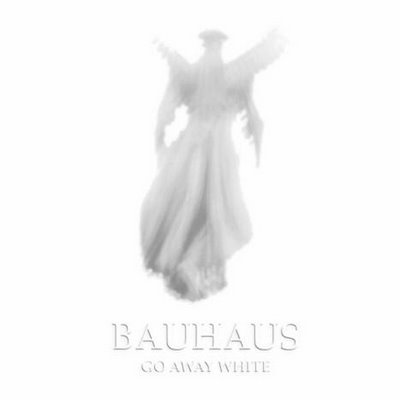
They’ve reformed several times since, the most recent reformation resulting in the new studio album Go Away White (Bauhaus Music, 2008).
This project unfortunately seems to have ended badly with no supporting tour and vows to never work together again following what is now referred to only as “the incident”, details of which the band seem exceedingly coy to reveal.
Track listing:
Double Dare
In the Flat Field
A God in an Alcove
Dive
The Spy in the Cab
Small Talk Stinks
St. Vitus Dance
Stigmata Martyr
Nerves
In the Flat Field has since been re-released an astonishing number of times by many companies around the world, the CD versions generally featuring numerous bonus tracks.
Line up: Peter Murphy (vocals), Daniel Ash (guitar), David J. Haskins (bass), Kevin Haskins (drums).
What’s that?
You wanted Bela Lugosi’s Dead?
Sorry, not on the album.
Then again, I guess not including it would be a bit like reviewing Led Zeppelin without talking about Stairway to Heaven, so by way of compromise, here it is, all 9+ glorious minutes of it - Goth's very own Stairway to Heaven.
A very happy new year to all of you who’ve visited Plunder the Tombs during its first four months of infancy.
And so, look what we have for you to kick off the new year – a free compilation documenting all (well, almost all) of the archeological discoveries so far uncovered.
To be honest, I’ve never tried doing something like this before, and hope like hell the download actually works, but I’m actually really happy with how this turned out, especially with regards to immortalising those bands whose back-catalogues have been long deleted.
Obviously, a number of other artists included here do have material that is still available, and nothing would make me happier than for folks who download this and discover bands that appeal to them to go, seek out, and buy more of those artists’ material.
What more can I say? I’m pleased as fuckin’ punch with this, and I think you will be too.
The thought occurred that some of you in the old school might actually want to run off hardcopies (rather useful to play in the car if nothing else), so I’ve put it in a 2 CD format.
What’s more, there’s even cover art and a track list to go, with production generously provided by Living Horus and featuring imagery by Jean Delville, one of my favourite artists of the Symbolist movement – just print it out, fold in half and presto – instant CD Cover!